Why Better Specs Couldn't Kill the Technics 1200
Vestax, Numark and Stanton all beat the Technics 1200 on paper. None of them took the booth. The deck only lost when Pioneer changed the format, and that same lock-in now protects Pioneer.
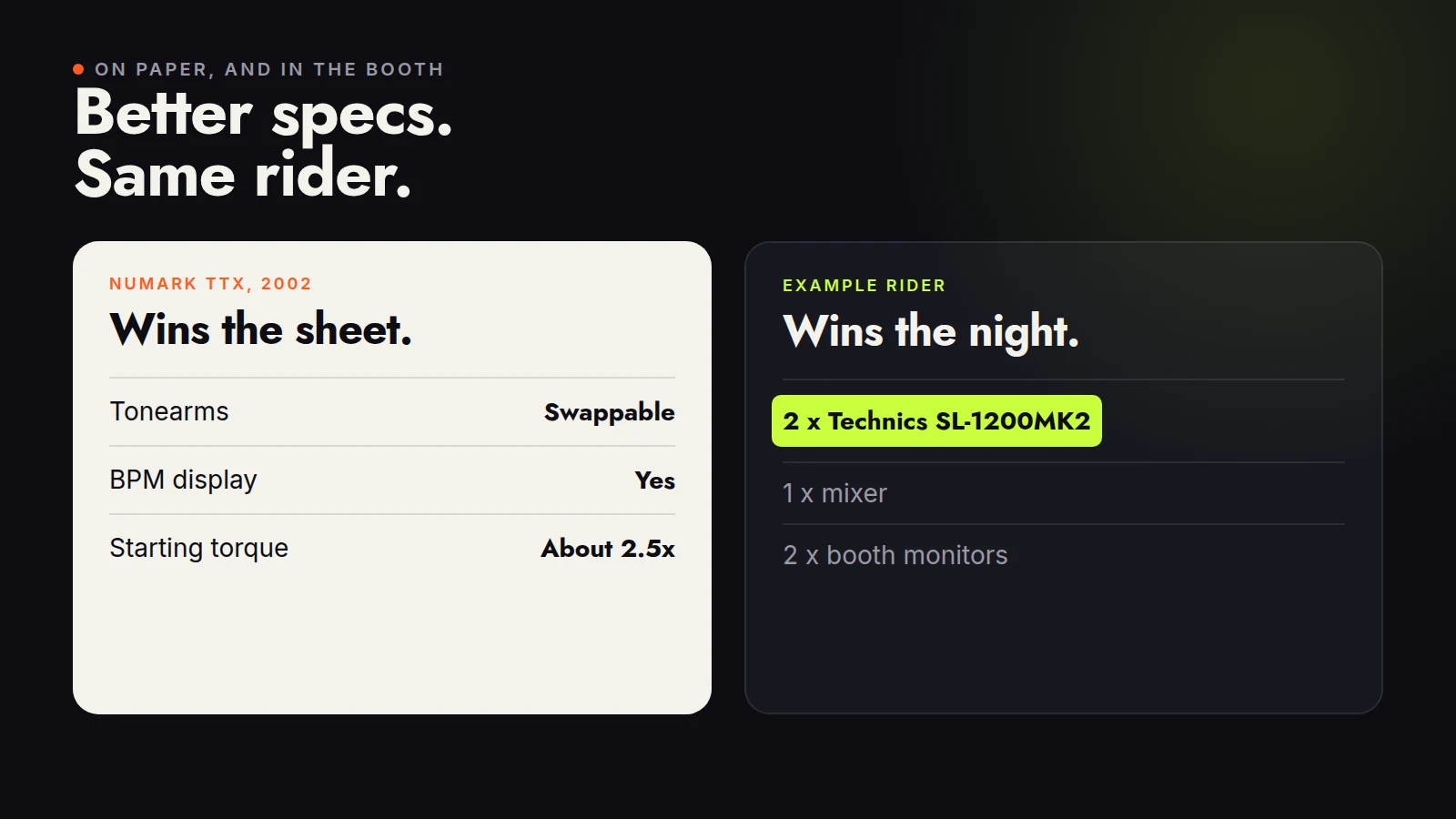
In 2002, Numark put out a turntable called the TTX. Swappable tonearms, a screen that showed the exact BPM, a digital output, and a motor with about two and a half times the starting torque of the deck it was built to replace. On paper, the Technics 1200 was finished.
It wasn't. Mark Settle at DJWORX bought the TTX over the obvious choice, then wrote that he couldn't think of one reason it shouldn't be in every booth, “except the Technics 1200.” The booth kept the same deck. Years later the same pattern turned up again, with Pioneer on the other side of it.
Why did the Technics 1200 become the club standard?
The Technics SL-1200 was never designed as a DJ tool. Technics launched it in 1972 as a home hi-fi turntable, direct drive, so the motor turns the platter itself and it holds its speed. Les Adams, better known as LA Mix, told DMC World in 2016 that it flopped as hi-fi, and that DJs turned it into the most iconic turntable ever built.
The MK2 arrived in 1979. About 0.7 seconds to speed, and 1.5 kilogram-centimetres of starting torque. Modest, next to what came later. What mattered was the DJ rider, the list of gear a venue is asked to provide. DJs asked for 1200s, clubs bought 1200s, and the next DJ learned on a 1200. Panasonic, which owns Technics, has put sales at about 3.5 million.
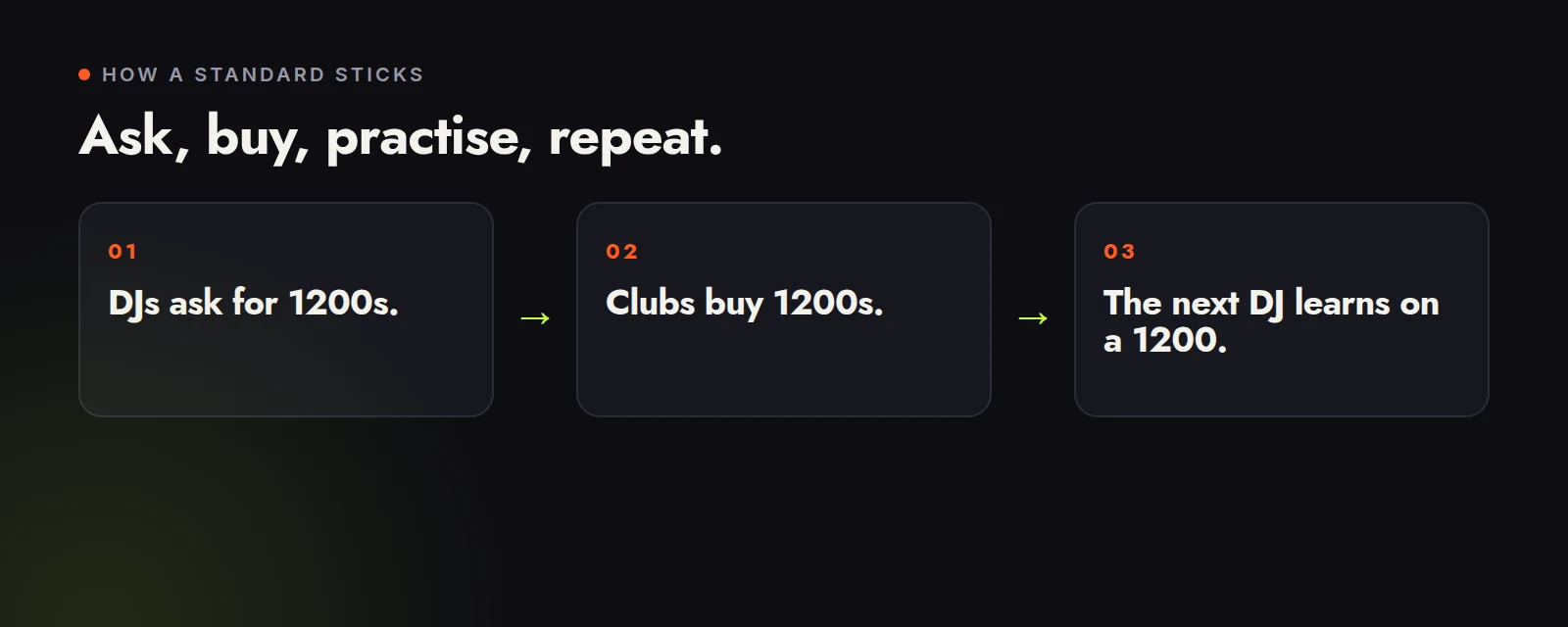
A rival had to retrain thousands of hands, and persuade venues to throw out decks that still worked.
Why did decks with better specs lose to the Technics 1200?
The Vestax PDX-2000 (2001), the Numark TTX (2002) and the Stanton STR8-150 (announced May 2003) each beat the MK2 on the sheet. More torque, more tricks, and in Stanton's case 16.4 kilograms against 12.5. The TTX's first batch overheated. Numark shipped a fix in 2003, but Settle wrote that the early reputation stuck, and that it would always be in at least second place. Booth size wasn't the Stanton problem either: its footprint is within a centimetre of a 1200.
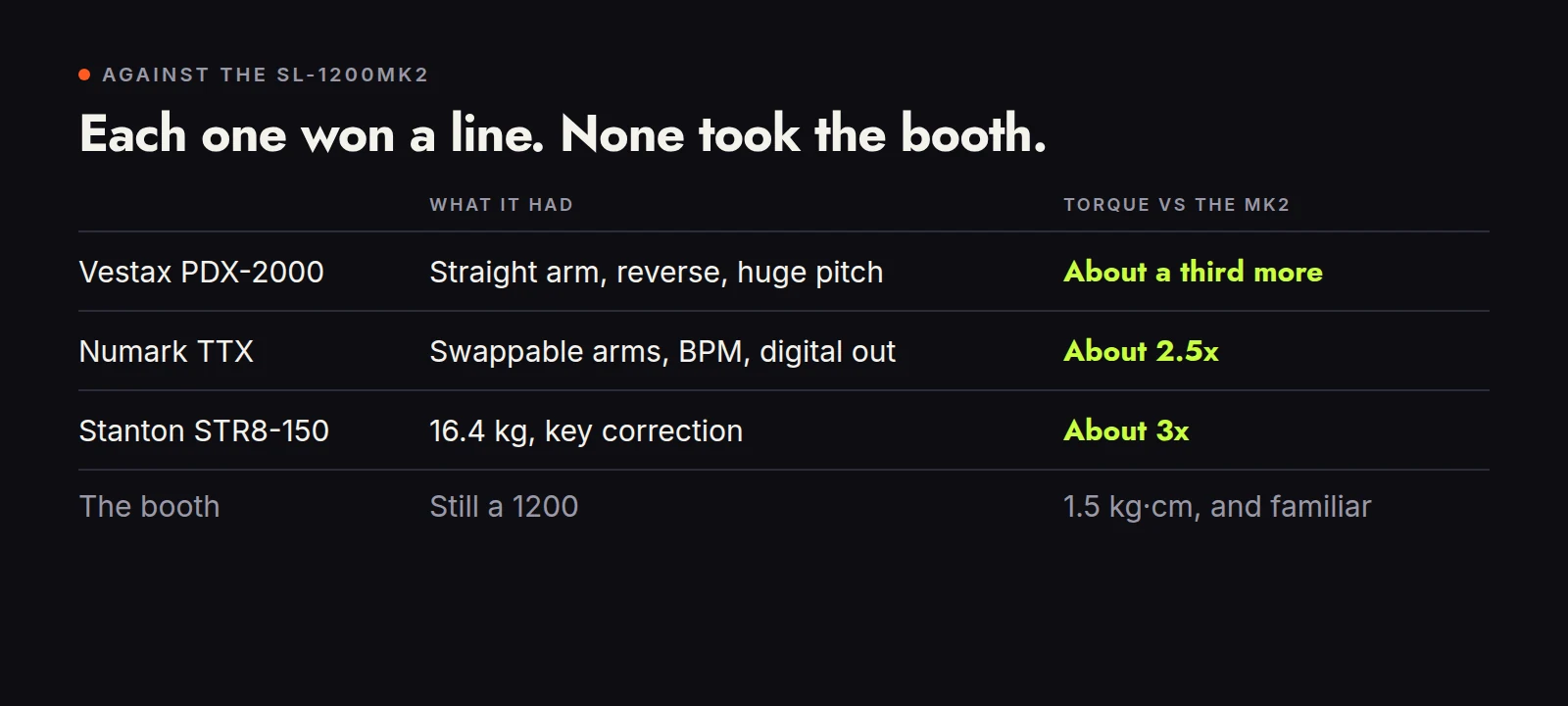
Straight arms, big torque, a huge pitch range, reverse: a scratch DJ's wish list, and with scratch DJs they did well. Most club DJs were beatmatching by hand, nudging a spinning platter all night. A motor that fights your hand is a problem for that job, not a feature. One Vestax owner who loved the motor on day one later sold it and bought a new SL. The features that won the demo made the actual work harder. They beat the 1200 at a different job, in the same way a great club DJ isn't automatically a great wedding DJ. The room in front of you is the spec that counts.
What finally replaced the turntable in the booth?
Not a better turntable. Pioneer changed the format.
Pioneer's first DJ product was the CDJ-500, in 1994. In July 2001 the Pioneer CDJ-1000 arrived, with a jog wheel you could nudge like a record. Pioneer calls it the de facto standard, and for once that line is fair. Serato Scratch Live, in 2004, let the 1200 carry on as a controller for a laptop.
When Panasonic stopped production in October 2010, it blamed the shift of the whole audio market from analogue to digital, and how hard the old parts had become to buy. Analogue turntable sales, Panasonic said, had fallen to about 5 percent of the level ten years earlier. Nobody had beaten the 1200 at being a turntable. The world needed fewer of them.
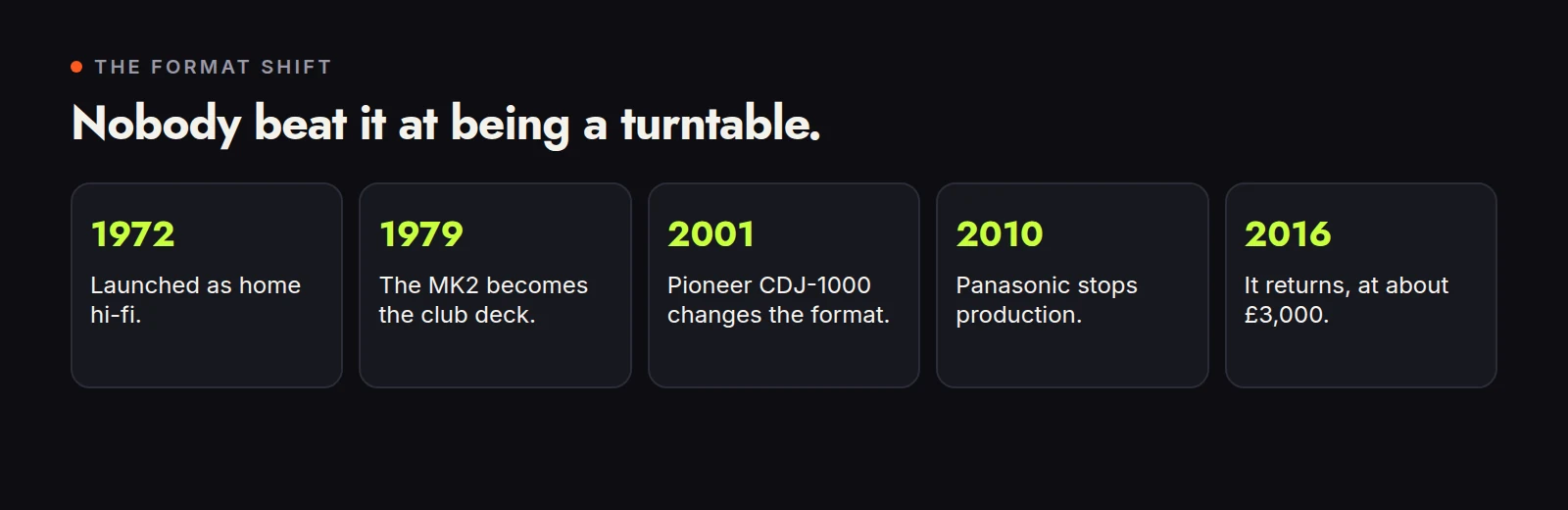
The timing, looking back, was brutal. Official Charts Company figures put UK LP sales at 205,292 in 2007. By 2016 the BPI, reported by the BBC, counted more than 3.2 million. Technics came back that year with the SL-1200G, at about £3,000, because the original tooling was gone. Panasonic called the MK7, in 2019, the first new standard DJ turntable in about nine years. In the gap, Pioneer launched the PLX-1000 (2014). Most of the DJ press read it as a 1200 clone.
Technics tried a digital deck of its own, the SL-DZ1200, in 2004. Panasonic's support pages say scratching with the key lock on doesn't sound like a normal scratch, MP3s stopped at 192 kilobits a second, and the memory card only played files written by Panasonic's own software. As far as we can find, Technics never made a DJ controller or its own DJ software. Pioneer did the opposite. rekordbox launched in September 2009 with the CDJ-2000: prepare the music at home, put it on a USB stick, walk into a booth that already has the players. That stick is the new rider.
Why is Pioneer living with the same curse?
Pioneer DJ now sits under AlphaTheta. In 2020 Pioneer claimed about 60 percent of the DJ market, speaking to Attack Magazine. A Digital DJ Tips census put it at 70 percent or more worldwide and, in their words, “basically 100 percent” of professional booths. That's their survey. Pioneer is the new industry standard, so somebody had to become the new Vestax.
Denon tried. The 2017 campaign was called Change Your Rider. The SC6000, in 2020, could play two tracks at once, had a 10.1 inch screen and Wi-Fi, and launched at $1,499 in the US, the same year the CDJ-3000 launched at £2,299. It could even read rekordbox collections. In September 2025 the CDJ-3000X added Wi-Fi and the same size of screen. As of October 2026 a CDJ-3000X is about £2,399, and an SC6000 is roughly £1,500 to £1,700. Denon still has dual layer, and the lower price.
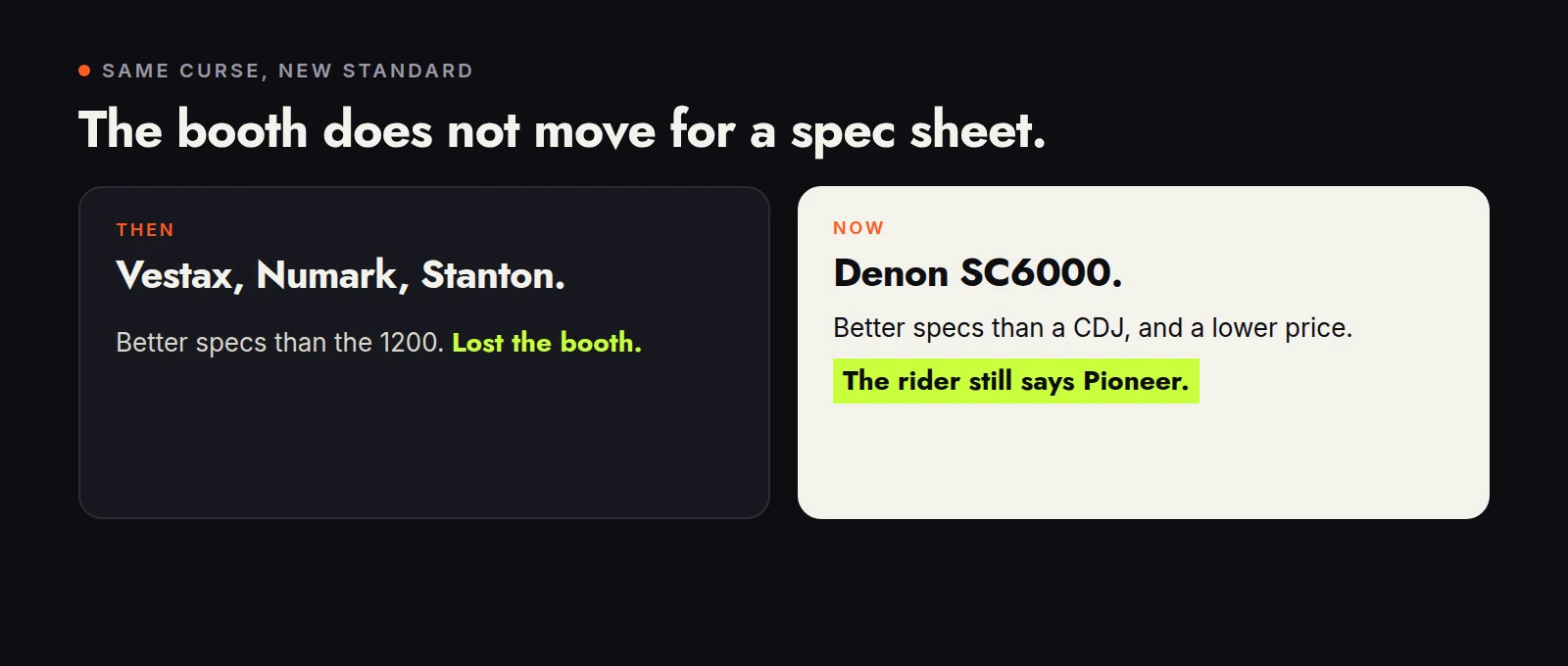
The lock-in was never really the hardware. It's the libraries already prepared in rekordbox. It's the riders. It's the rental companies, and the venues that have already paid for a booth full of CDJs. A DJ doesn't switch players. A whole scene has to switch at once. Exactly like the 1200.
What should you actually listen for?
The 1200 didn't win because it was the best turntable ever made. It won because it was the one in every booth, and the one in every DJ's hands. In this business, “everyone already knows how to use it” is the hardest spec there is to beat.
If you're booking someone, a famous brand on the rider tells you what the club owns, not how this DJ plays. A mix does. We've written about why a DJ's mix tells you more than a testimonial, and a kit list is the same sort of dead end. Specs are a bad way to choose a deck, and a worse way to choose a person.
That's the idea behind DeckGigs: hear before you hire. Profiles show real mixes, starting rates, genres, town and how far a DJ will travel. Mixes can be labelled for the kind of night, including clubs. If you want someone for a bar or a club, start by listening to DJs who play bars and clubs. Ten minutes of a set will tell you more than the logo on the player ever will.
Quick answers
Why did the Technics 1200 beat turntables with better specs?
Vestax, Numark and Stanton beat the SL-1200MK2 on torque, pitch range and features aimed at scratching. Most club DJs were beatmatching by hand, and clubs already owned 1200s because riders asked for them. A rival had to retrain a whole scene, not win a spec sheet.
What replaced the Technics 1200 in club booths?
Not a better turntable. Pioneer changed the format with the CDJ, then locked the booth in with rekordbox and USB sticks. Panasonic stopped SL-1200 production in October 2010 and blamed the shift from analogue to digital.
Is Pioneer the new industry standard for DJs?
Pioneer, now under AlphaTheta, claimed about 60 percent of the DJ market in 2020. A Digital DJ Tips census put it at 70 percent or more worldwide and, in their words, basically 100 percent of professional booths. That second figure is their own survey.