The Hidden Cost of Booking a DJ Through an Agency
Agencies and booking platforms are paid from the booking itself, usually as a percentage of the fee. Here's where that money comes from, what else you give up, and when an agency is still worth it.
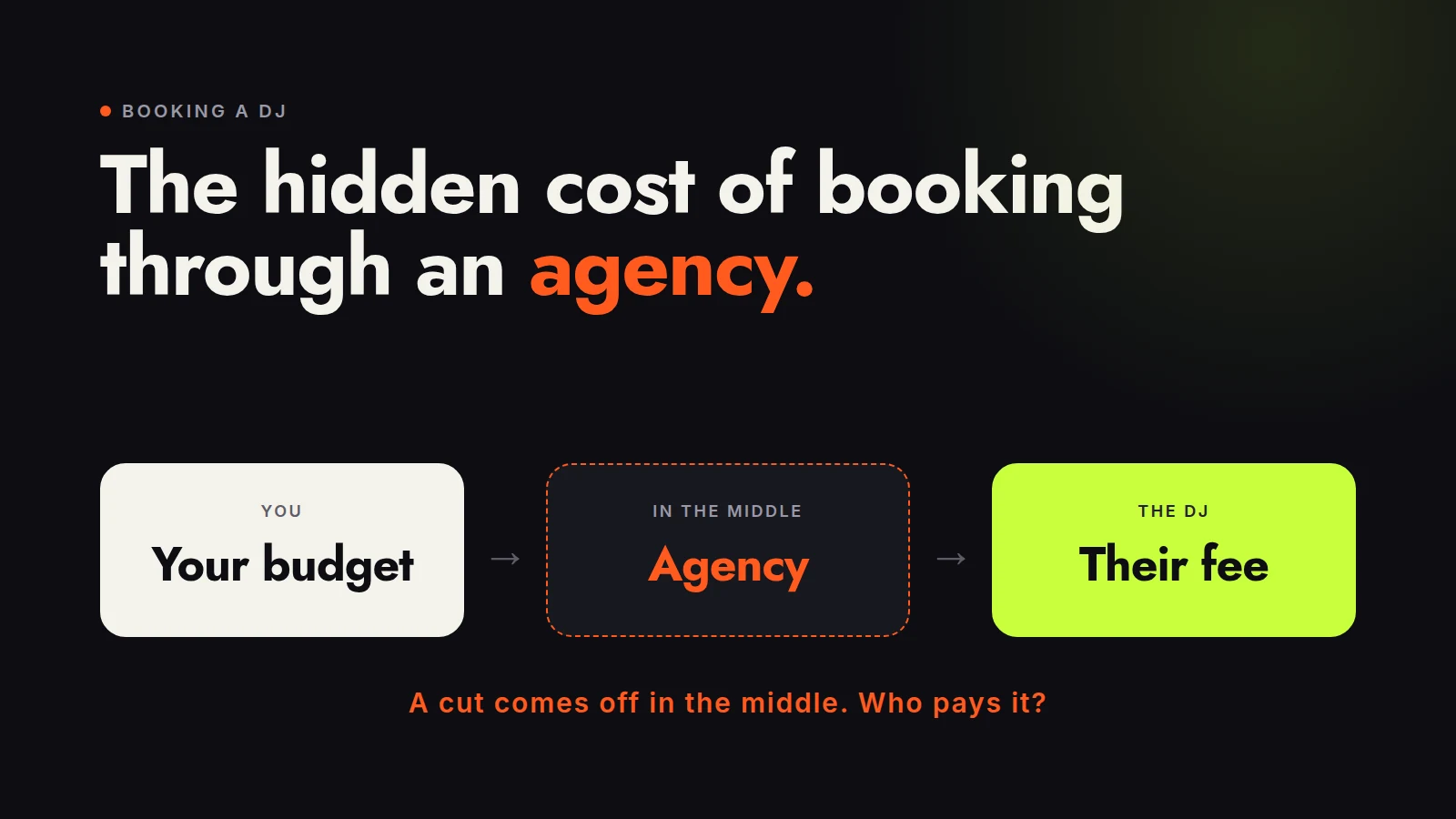
Booking a DJ through an agency feels like the safe option. One email, one contact, someone else does the chasing. But there's a cost you rarely see on the quote: someone in the middle takes a cut of the fee, and you get further away from the person who'll actually be playing your night.
That doesn't make agencies bad. Plenty do a good job, and for some events they're the right call. But if you're weighing up a DJ agency against booking a DJ direct, it helps to know where your money goes and what you give up along the way.
How does a DJ agency make its money?
An entertainment agency (a business that finds and books performers on behalf of clients) has to be paid from somewhere, and that somewhere is the booking. The usual model is agency commission: a percentage of the performer's fee. So what do DJ booking agency fees actually look like?
For traditional agents, the Musicians' Union tells its members that usual rates are in the 10 to 15% range, and advises them not to agree to more than 15% without checking with the union first. Online booking platforms publish their own terms. Poptop takes a 12% commission on the full booking value, and Encore takes a 20% service fee on the total quote, both from the performer's side.
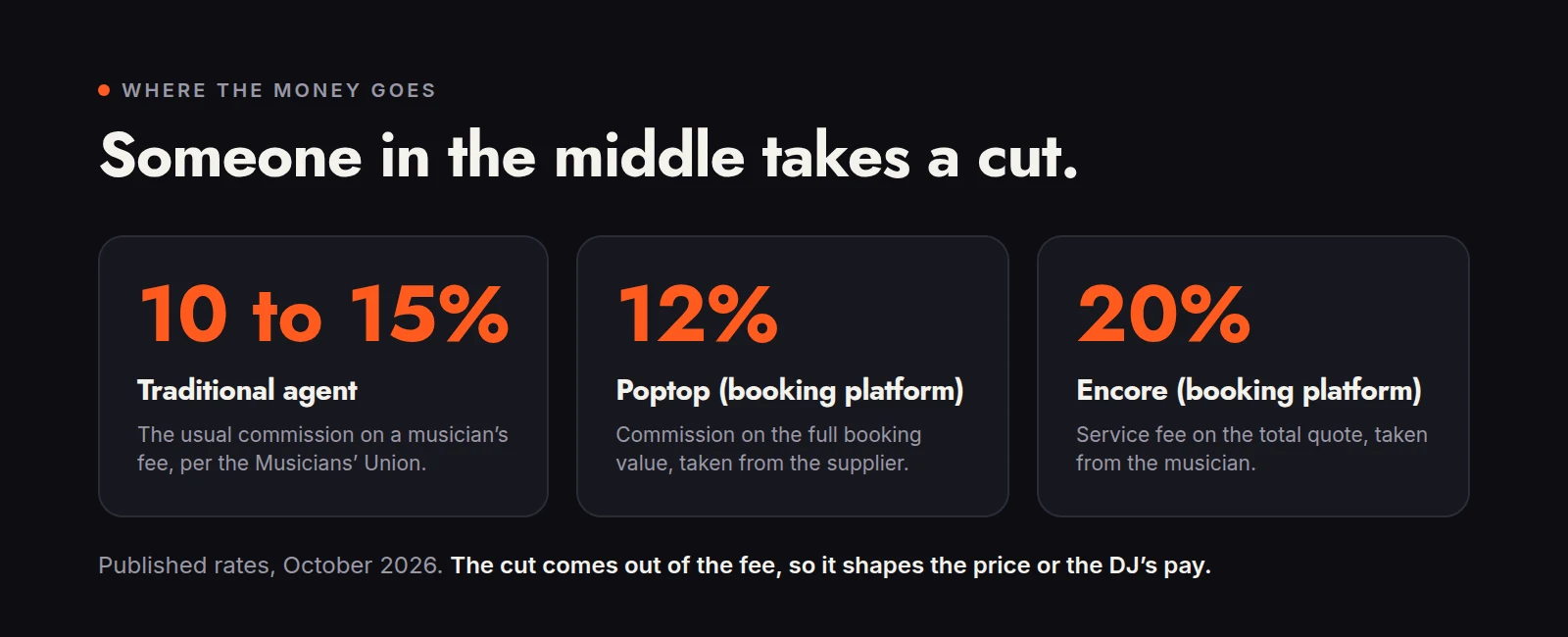
Here's the part that matters to you. That cut doesn't appear by magic. A DJ who knows a fifth of the fee will come off either builds that into the price, or takes home less for the same night's work. Either way, part of what you pay isn't going to the person behind the decks.
We haven't found any reliable data on how much more clients pay on average when they book through an agency, so we're not going to invent a number. What we can say is that the agency's cut is real, published and paid for by the booking.
The costs that don't show up on the invoice
Money is the obvious one of the hidden costs of booking a DJ this way. The less obvious costs are about distance.
You talk to a booker, not the DJ
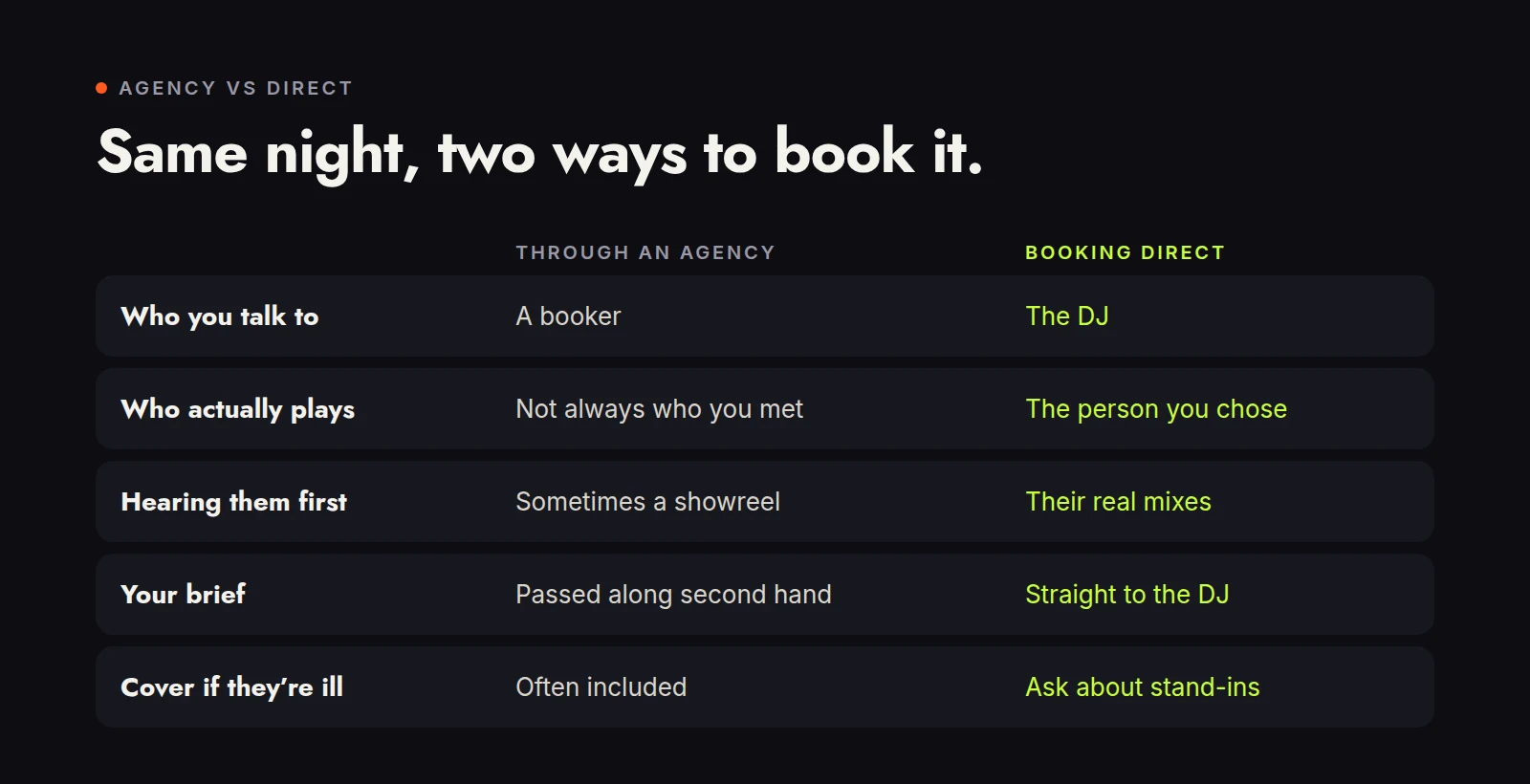
Your brief, the crowd, the must-plays, the "please don't play" list, the timings around the speeches: it all goes to a booker, who passes it on. Some of it survives the trip. The DJ you meet on the night may be hearing half of it for the first time.
The DJ you liked may not be the DJ who turns up
Some agencies run a roster and assign whoever is free closer to the date. That can work well, but it means the person on the promo video isn't guaranteed to be the person at your venue. We called this one The Shapeshifter in our guide to avoiding a DJ booking horror story.
You rarely hear them play first
Agency websites tend to lead with photos, logos and a polished showreel. A showreel shows you the highlights. A full mix shows you how a DJ actually builds a night, which is why we think a DJ's mix tells you more than any testimonial. If you can't hear the specific DJ you're getting, you're booking blind.
When an agency is worth it
To be fair to agencies, there are good reasons people use them. A decent one gives you a single point of contact, handles the paperwork and often has other DJs on hand if yours falls ill. For a large corporate event with several acts, or a booker who simply doesn't have time to deal with suppliers one by one, that can be worth paying for.
The question is whether you're paying for something you need, or paying for a middleman because it's the only way you knew how to find a DJ.
Online booking platforms sit somewhere in between. You usually browse profiles yourself, which is a big step up from a blind booking, but the platform's fee still comes out of the booking, and some ask that all payment and messages stay on their system. Read the terms so you know who you're actually dealing with.
What to ask if you do use an agency
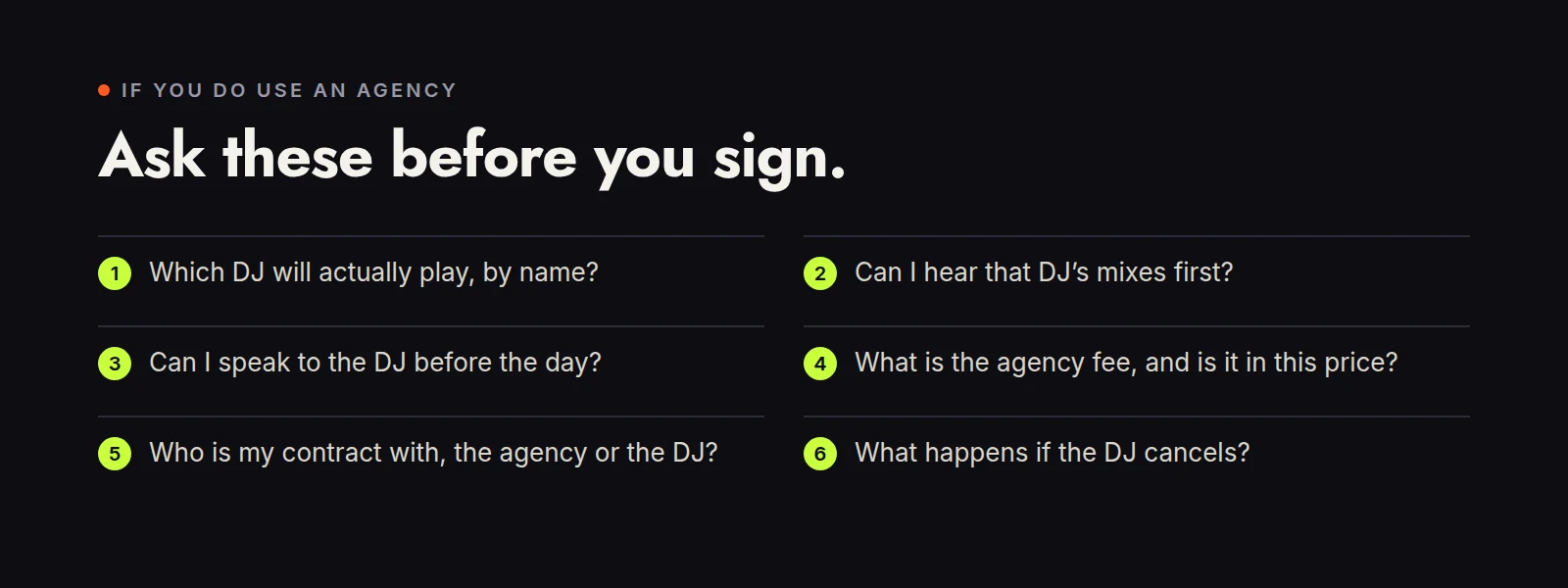
- Which DJ will actually play, by name?
- Can I hear that DJ's mixes, not just a showreel?
- Can I speak to the DJ before the day?
- What is the agency's fee, and is it already in this price?
- Who is my contract with, the agency or the DJ?
- What happens if the DJ cancels?
A good agency will answer all six without fuss. If the answers are vague, that tells you something too.
How to book a DJ direct
Booking direct used to mean scrolling Instagram, sending DMs and waiting days for "it depends" to turn into a price. That's the bit DeckGigs is built to fix.
DeckGigs is a marketplace, not an agency. We don't take a percentage of your booking, and the booking itself is an agreement between you and the DJ. Every profile shows the DJ's real mixes, a starting rate and how many hours it covers, their genres, where they're based and the dates they've marked as free. You message the DJ directly, so your brief reaches the person who'll be playing it.
If you're still working out a budget, our guide to how much a DJ costs in the UK breaks down typical prices, what's included and what tends to cost extra.
Browse DJs on DeckGigs, press play on a few mixes and talk to the one who sounds right. Hear before you hire, and keep more of your budget on the dance floor.
Quick answers
How much commission does a DJ agency take?
The Musicians' Union says traditional agents usually charge musicians 10 to 15% of their fee. Online booking platforms publish their own rates, such as 12% on Poptop and 20% on Encore.
Is it cheaper to book a DJ direct?
There is no reliable data on the average difference, but booking direct means no agency commission comes out of the fee, so more of what you pay goes to the DJ. Always compare quotes that cover the same hours and inclusions.
When is a DJ agency worth using?
An agency can be worth it for large events with several acts, or when you want one point of contact and backup cover if a DJ is ill. Ask which DJ will play, whether you can hear their mixes, and what the agency fee is.